Tuesday, October 5, 2010

Preparing For Transplant Surgery

A couple days ago, I wrote about my new car (http://svgreatwhite.blogspot.com/2010/10/my-new-car.html ). Last night my friend Jim and I took his car trailer to Tacoma and hauled her to my home. I will unload her today and put her into the garage. Now I can tell what I have in store for this car.

But first, a little background story. In 1984 I bought a Ford, Bronco II. This was prior to the popular term "SUV", but it had a lot of the same attributes: truck chassis, 4 wheel drive. I used it a lot as a daily driver, hauled bicycles, went skiing, camping and travelled in the hills on undeveloped roads. I still own it, but it is getting old and has a lot of miles. Although Mr Bronco has been very dependable, the drive train was not known for lasting a long time and the 2.8 liter, V6 engine does not have a good parts support system and needs additional fluids often to keep running right. Other than that, the body, paint and interior are in great shape. He has always been parked undercover. He always been a comfortable vehicle to drive. I just have not been comfortable taking him very far from home.

Something I always wanted to do was repower Mr. Bronco with a V8 engine. This is really a fairly common procedure. Recently I started studying what it would take. I found sources for the adapter parts and was looking for engines. I found a blog of a guy that installed a V8 in his 1984 Bronco II in ten days. He found a 1977, Ford Granada with 47K miles and used that as a "donor" car. As I was looking for engines, I looked in Craigslist and sure enough, there was Ms. Granada, a 1977, Ford Granada with 63K miles. Can you see where this is going?

So, I bought Ms. Granada to be a "donor" car. I did not want her for her body, but I wanted her for her heart and soul: her 302 cubic inch V8 engine and her C4 automatic transmission. The engine and transmission beat strong within her mangled body and my plan is to transplant them into Mr. Bronco.

Today, I rolled Ms. Granada off the trailer, pried the fender well farther from the rear tire and took her for a short drive. She started right up. She seems to have a fair amount of power and shifted smoothly. I have always been impressed with how quiet her V8 is. It really is quite a shame that she was wrecked. She would have been a great work car or daily driver.

Many have commented on this blog and in Facebook about the repair work that is needed on Ms. Granada. She is gone, her frame is twisted and bent and the left rear sheet metal is destroyed. But her heart should beat strong in Mr Bronco and provide a long life to him. Much of Ms. Granada's body can be reused by the right person that needs parts and after I harvest all the parts I need, I hope to get her body into the hands of someone who can distribute what is left of her. The remains of her body and interior is in great shape!

Stay tuned in the coming months as I start the transplant process. I will blog when I have significant news to report. And like the Six Million dollar man, Mr Bronco will be rebuilt to be "better, stronger, faster".

Ms. Granada on the car trailer parked in the cul-de-sac at my home.

Ms. Granada waiting to be unloaded.

Ms. Granada unloaded and waiting to be moved into the operating room, AKA my garage. Need to get her out of sight before the neighbors complain!


Mr Bronco. Hopefully by the end of the year he will have a new, stronger heart!

Monday, October 4, 2010

1-800-GO.AAMCO For Transmission Problems

Today, I headed out for a 24 mile bicycle ride. I chose the older white Cannondale road bike. It has a lot of miles, but I have kept it upgraded to newer components.

I knew something wasn't right as soon as I made a few shifts with the rear derailleur. The shifts were just not as crisp as I was used to. Sure enough about 10 miles into the ride, the rear derailleur cable broke. This is not the first time I have had this happen, so I had a plan to fix it so I could at least get home.

This bike has 9 sprockets on the rear wheel and 2 chain rings on the crank for a potential of 18 speeds. When the cable breaks, the derailleur moves over to the smallest sprocket which is the highest gear. I positioned the derailleur over the third largest sprocket and locked it in place by clamping the remaining shifter cable under the rear wheel quick release nut. Now I had a two speed bike with one sprocket in the back and two chain rings in front.

I decided to continue my ride instead of taking a short cut home. The gearing was way low, even with the big chainring, for the flats and downhills. And on the climb out of Illahee, I could have used a lower gear. But I made it home and had a fast average too.

Since this has happened before, you would think I would carry a spare cable..... Nah!

Here is the rear sprockets or cogs. After I positioned the derailluer at the third largest cog, I pulled all the slack out of the shifter cable and clamped it under the red rear wheel quick release nut to hold the derailluer in position.

Sunday, October 3, 2010

My New Car

Today, I bought a new car. Well, it is new to me. It is a 1977, Ford Granada, 302 Cubic inch V8 with 63000 miles. Runs really good, needs a little body work. Probably will just buff out. I will take delivery on tuesday and haul her home on a trailer. She is a beaut, isn't she?

More info later.


Saturday, October 2, 2010

Foulweather Bluff Race-Oct 2nd

Saturday was the Foulweather Bluff Race. This race is sponsored by Edmonds Corinthian Yacht Club. It starts north of the Edmonds Ferry Dock, rounds the government buoy at Foulweather Bluff , rounds the buoy at Schatchet Head and returns to the start/finish area. Normal length for the long course is 26 miles. There is a short course that goes to a temporary buoy at Pilot Point instead of Foulweather Bluff. This is used for the smaller boats and a short course for the larger boats if there is not much wind at the start. More on this later.

I took "Great White" to Edmonds on Friday. I arrived at the public moorage at about 1200. I was the first to arrive, but by evening the moorage was full and I had two boats rafted to me. It was a great day for a delivery and I took some time and walked up town and to the antique mall.

Saturday was suppose to have light winds and the weather forecasters were right on. We motored to the starting area and waited while a postponement was called for lack of wind. We drifted around for about a half hour before enough wind drifted in to begin starting boats. The committee also decided to send us on the shorter course to Pilot Point..

We finally got to our starting time. I had a terrible start. One boat that started five minutes after us got up to the line and got in our way. I had to slide down the line and start to leeward of the class. We opted to stay low and try to work out from underneath the other boats and their bad air, but I also wanted to get across Puget Sound first to get relief from the adverse current along the Kitsap shore. We worked forward of the windward boats, got clear air, but also got a header that helped move us ahead of some of the boats in our class. We also started getting better wind. By the time we reached the Kitsap shore, we seemed to be in the lead, but one boat("Marayui", Benetau 36.7) crossed just ahead of us. The wind increased to about 11 knots and we short tacked along the beach and made distance against other boats that went farther offshore into the adverse current.

We rounded the mark ahead of "Marayui" in the lead. The course to the next mark at Schachet Head was a close reach. Many boats went high on the course. I resisted the urge to go high especially since the current at the next mark was flowing from right to left. If we would have stayed high, we would have had to take a slower route against the current to the mark.

Again, we rounded the second mark in the lead. We set the spinnaker and headed for the finish. I concentrated on sailing hotter angles and we jibed several times. We put distance on "Marayui" and held our own on "Elusive"(C&C115) and "Uno" (Sierra 26). "Elusive" is fast downwind and "Uno" is a real downwind flyer. Fortunately they rate the same as us and all we had to do was stay between them and the finish. We owed "Marayui" a little less than two minutes.

We finished first, "Uno" was second and "Elusive" third. "Marayui" finishe far enough back that the first three finishers corrected on them. One disappointment was that the committee did not give us a gunshot for finishing first in our class. They fired the gun for "Uno". They made a mistake.

This was probably the most exciting race for me this year. Our class consisted of closely rated boats and the closeness of the rating showed that. Once the sun came up, the weather was spectacular. We had great teamwork. Thanks to the crew of Jim, Kathleen, Michael and Dave.

I left at about 1700, righ after the awards ceremony and had a nice motor home in very calm conditions. Arrived back to my moorage at about 1900.

Total distance for the weekend: 50.7 NM.

Edit: The results are posted at
http://cycedmonds.org/ and it appears that "Marayui" actually placed 2nd and "Uno" was 3rd. We corrected ahead of "Marayui" by about 30 seconds.


The harbor filled with boats Saturday morning.
Some last minute work up the mast on "Dulcinea".

Some last minute work up the mast on "Dulcinea".

Light winds before the start.

Still light winds, but a couple classes started.

Our course for the day. We went clockwise.
As we crossed Puget Sound, we had a header right after the start and then a constant lift as we approached the Kitsap Shore. We then short tacked close to the beach on the Kitasp Shore(left side) to escape the flooding current. And tacked downwind to the finish on the right to keep our speed up.

Wednesday, September 29, 2010

Inclining the Schooner "Lavengro"

The Schooner "Lavengro" is a classic gaff-rigged Biloxi Schooner. The Biloxi Schooner fleet once sailed the Gulf of Mexico harvesting oysters and shrimp. "Lavengro" was built in 1927 and is operated by the Northwest Schooner Society (http://www.nwschooner.org/) which uses historic ships to teach people about the history and operation of a classic sailing ship. It has been designated as the official Kitsap County "Tall Ship". Info on "Lavengro" can be found here: http://www.schoonerlavengro.com/

Since "Lavengro" carries passengers, it has to be certified by the Coast Guard. One of the requirements is to prove the stability of the vessel. This is accomplished by performing a test called a Inclining Test. This is simply placing weight near the rail of the vessel and see how far it heels (or leans) over. Calculations are prepared in advance and the amount of weight used and the maximum amount of heel is known in advance. The test is to verify the validity of the calculations.

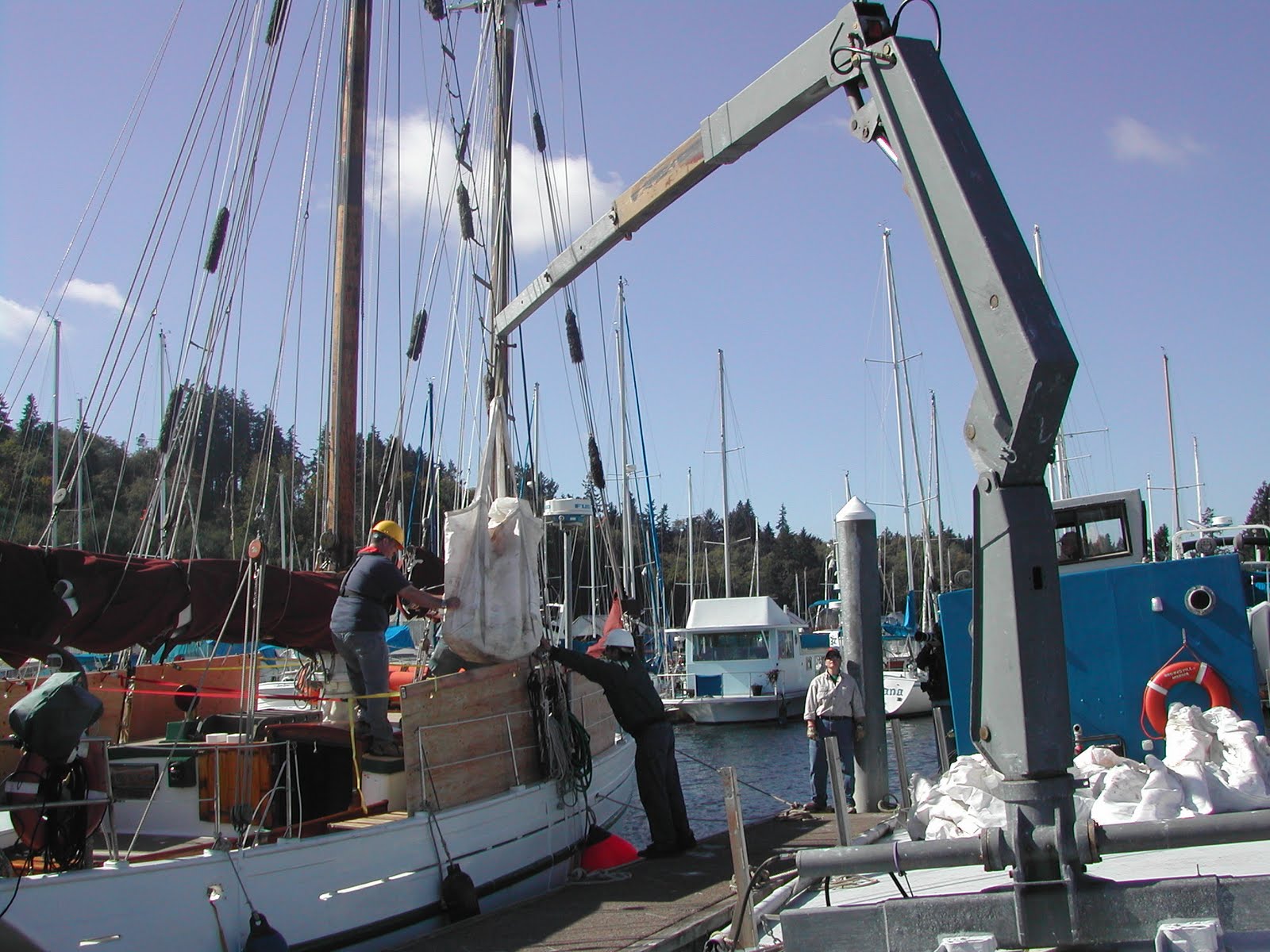
"Lavengro" moors at the Brownsville Marina(where I moor my boat) and the port personnel used their work boat to move the weights on and off the deck of "Lavengro". A large group of "Lavengro's" crew and volunteer were on hand to help. The Coast Guard was on hand to witness the test and the local newspaper had a reporter and photographer to document the proceedings( http://www.kitsapsun.com/ ). I was there to watch and get in the way!

Nearly 7000 pounds of iron ingots were first loaded on deck evenly split between port and starboard sides. This was to simulate the weight of a full load of crew, passengers and provisions. This was to establish a "load line" that would indicate a full load. The weight was then removed from the port side and placed on the starboard side. With the full weight on the starboard side, the criteria was that the deck/hull intersection could not be underwater. This was to represent the load of the wind with the full complement of sails set.

When it was all done, "Lavengro" passed all tests satisfactorily.

Schooner "Lavengro" 63 feet overall length, 48 feet long on deck, 44000 pounds, 1370 square feet of sail area.

Loading the first bags of iron ingots onto the starboard side.
With half of the weight on the starboard side, "Lavengro" being moved to the other side of the slip to load the other half of the weight on the port side.
Loading weight on the port side.
Back to the starboard side, the total weight of nearly 7000 pounds loaded on deck.
The maximum heel with all the weight (and two men) on the starboard side.
Maximum heel.
Maximum heel.
Unloading the weight.
With most of the weight removed, "Lavengro" sitting more upright.

Friday, September 24, 2010

The Fourth and Final September Six Pack Series Race. I Am Glad This One Is Done!

Tonight was the last race of the four race September Six-Pack series.

About an hour before I was ready to leave the house, a package arrived. My autopilot computer was finally back from the repair facility in New Hampshire. It had been acting up for several months. I performed diagnostic tests and determined that the fault was not in the compass. The tech at Raymarine confirmed that the problem was probably in the computer. So, in mid August I sent the unit to the repair facility. They repaired several circuits and installed the latest software.

I hurried down to the boat and reinstalled the computer and got underway to perform the calibration procedure. Once that was done, I headed to Port Orchard. The autopilot worked great, probably better than it ever has. It was nice to have it again during the delivery. It is illegal to race with it.


The race got underway in about 6 knots of wind out of the SE. I had a OK start just behind Tantrum II. I was able to go through there lee and pulled ahead. Rounded the first and set the spinnaker for the run north. About half way to the next mark the wind lightened and came ahead. Up went the jib and down came the spinnaker.

I worked through the two classes of boats that had started ahead of me. I got to the mark first and rounded it to port. I sailed about 50 yards toward the finish when the boat behind me informed me that I HAD ROUNDED THE MARK THE WRONG WAY! How stupid! I jibed around to reround the mark . Tantrum II, Falcon and Tantalus got past me before I rerounded. Those three boats stayed ahead of me and set spinnakers. I did not set a spinnaker, but reached up toward the left shore. I got some new wind and closed a lot on Tantalus, but could not pass them. Tantrum II won my class, Tantalus was second, I was third. Falcon was a division II boat and won their class and won overall. For the series, I won Division 1 and probably overall.

And with the race tonight, the summer evening series are over and we go back to weekend racing. The June and September Series were a lot of fun and a good chance to get out on the water. And now the rest of the story: I sailed all eight races alone. There should have been no way I could have won almost every race.
Oh, and the delivery home in the dark was great. Calm , warm and a huge full moon lighting the way!

Approaching the first mark.
Picture credits: Robert Hennessy
Rounding the first mark.
Photo Credits: Robert Hennessy

Friday, September 17, 2010

Six Pack Series-Race #3

Tonight was the third race of the Six Pack series in Port Orchard. Tonight I decided to eliminate confusion among my competitors by leaving my luck at home. I did not want luck confusing anyone.

The wind was light at around 5 knots at the start and it started raining hard. I had a good start on time about three boat lengths down the line from the boat end. We were being sent north to a radar target north of Retsil. I took a long starboard tack toward Bremerton. "Tantalus" and "Tantrum II" were to weather and pointing high and seemed to be getting a lift toward the right. I kept my speed up and pulled ahead some. My plan was to get far enough to the north to pick up the ebb flowing out of Port Washington Narrows. Sure enough, before I could tack and lay the mark, I detected on the GPS that the current was setting me right toward the mark. I soon was set to weather of "Tantalus" and "Tantrum II". As we neared the mark, the smell of the Retsil sewer plant became noticeable indicating a new breeze coming from that direction. I tacked twice to stay to the right side of the mark and in a lightening wind rounded the mark first where the committee boat shortened the race. Several boats went north of the mark and had quite a struggle to get up current to the mark.

I was first in class and first overall for the night. "Falcon" finished close behind me for first in class 2 and 2nd overall. Another fine evening although it rained hard the entire night. I collected my six packs of sodas(I don't drink beer) for the three races so far and headed home. The dark, rain and fog made it fun getting home. I was back to the dock at 2134 and home by 2206.

Since I left my "luck" home tonight, how do I explain my success? Maybe it was the symbiotic relationship between me and the boat where we are on the same path of going fast through the water...... Nah!!!
Light winds after the start. Left to right: Tantrum II, Tantalus and Swan.
Falcon off Annapolis. Retsil is toward the left.